
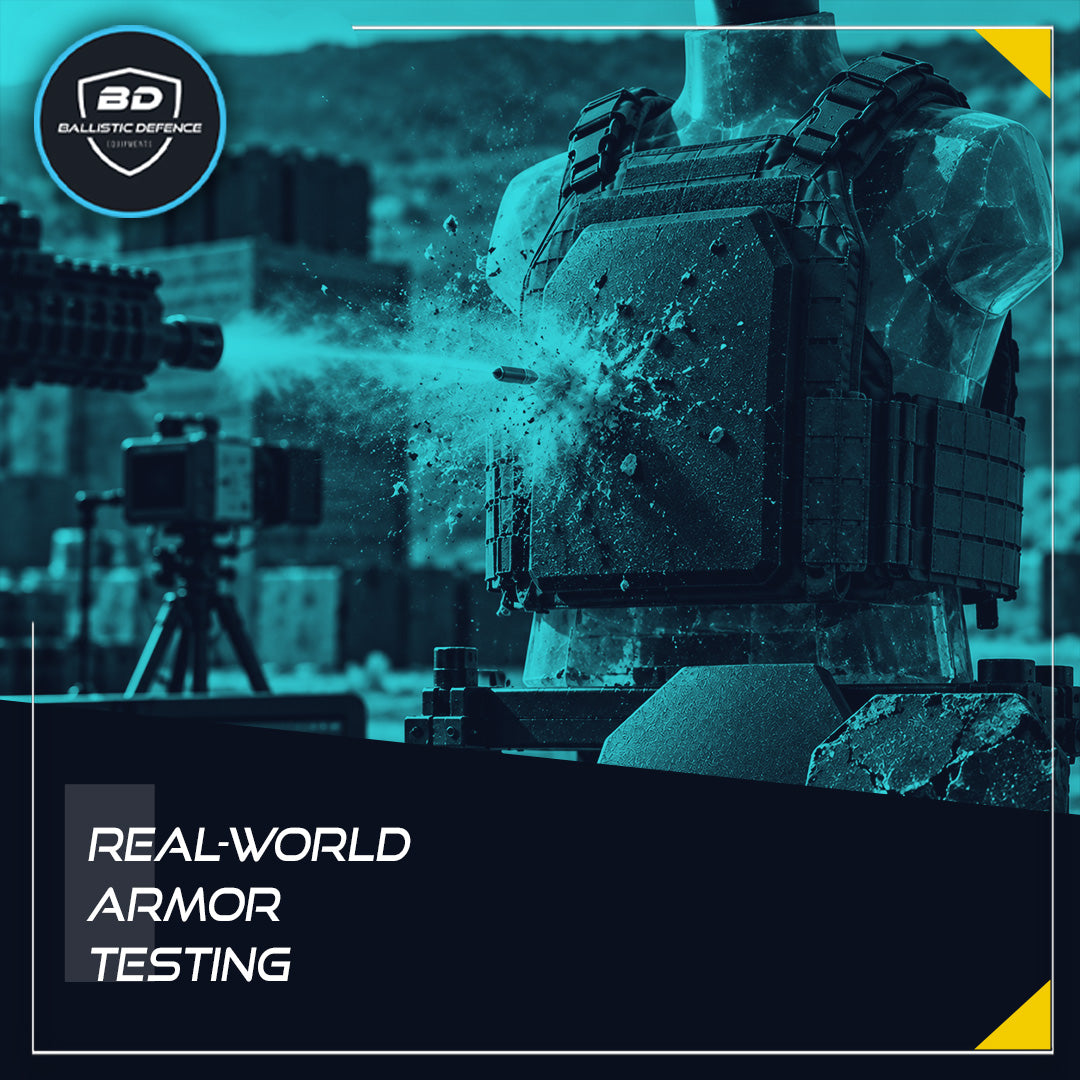
When your life depends on a plate, you need to know the testing behind it is real - and real-world body armor testing is what separates certified protection from marketing theater. A YouTube clip of someone shooting a plate in a field proves almost nothing; a documented NIJ certification process proves a great deal. This guide explains exactly how body armor is tested, what the NIJ 0101.07 standard measures, how to read lab results, and which claims you should trust versus ignore in 2026.
Why Standardized Testing Exists
Before national standards, armor claims were unverifiable - every maker set its own rules. The NIJ (National Institute of Justice) standard created a single, reproducible protocol so a Level III plate from one maker means the same thing as a Level III plate from another. Standardized testing controls the ammunition, velocity, range, shot placement, and measurement method, removing the variables that make backyard demonstrations meaningless. When a plate is NIJ-certified, it passed the same gauntlet as every other certified plate.
Inside NIJ 0101.07: The Current Standard
NIJ 0101.07 reorganized armor ratings around threat types rather than ascending Roman numerals. Handgun protection is now HG1 (9mm FMJ and .357 Magnum JSP) and HG2 (the faster .357 SIG and .44 Magnum). Rifle protection is RF1 (7.62x51 M80 ball, 5.56 M193, 7.62x39 mild steel core), RF2 (everything in RF1 plus 5.56 M855 "green tip"), and RF3 (.30-06 M2 armor-piercing). Understanding this framework is essential; our guide on NIJ body armor levels in 2026 breaks each rating down caliber by caliber.
What the Test Actually Measures
Certification evaluates two failure modes. The first is penetration - the round must not pass through the armor. The second is backface deformation (BFD) - the dent left in a clay backing behind the armor, which models the blunt trauma transmitted to the body. For hard armor the BFD limit is 44mm; exceed it and the plate fails even if the bullet didn't penetrate. This is why "it stopped the round" is only half the story: a plate that stops penetration but deforms excessively can still cause serious internal injury.
The Clay Backing and Shot Sequence
Armor is clamped against a block of calibrated Roma Plastilina clay, conditioned to a specific consistency and verified with a drop test before each series. Plates are shot in a defined pattern - multiple rounds at specified locations including edges and near-prior impacts - at controlled velocities measured with chronographs. Environmental conditioning (heat, humidity, tumbling) simulates field wear before some tests, so armor must perform not just fresh but after abuse. This rigor is what a field video can never replicate.
Standalone vs. In-Conjunction Testing
Plates are certified either as standalone (they meet the rating alone) or in-conjunction-with (ICW, requiring a specific soft backer). This distinction is tested, not assumed. A standalone Bedrock Level IV Multi-Curve Plate reaches RF3 protection on its own, while some lighter plates only reach their rating with a backer. Knowing which you have is critical to understanding your true protection.
How Materials Behave Under Fire
Different materials pass the same test by different physics. Ceramic composites shatter the projectile and absorb energy by fracturing - excellent against armor-piercing rounds, which is why Level IV plates are ceramic-faced. UHMWPE catches and deforms rounds in a flexible polymer matrix, giving the lightest rifle plates like the Bedrock Level III Multi-Curve Plate their weight advantage. Aramid weaves trap handgun rounds across many fibers, the basis of soft IIIA panels such as those in the Preis Level IIIA Concealable Vest. For a rigid handgun-rated insert, a Bedrock Level IIIA Multi-Curve Plate shows how little UHMWPE is needed to defeat pistol threats.